You got a sidewalk letter from the City. Take a breath — here's what it actually means.
If the City of San Diego sent you a Notice of Responsibility about the sidewalk in front of your property, you're not in trouble — but you are on a clock, and it's worth understanding exactly what the letter does and doesn't say before deciding what to do.
Why you got it
Someone — a neighbor, a pedestrian, a City crew — reported damaged sidewalk at your address, usually through the City's Get It Done system. The City inspected, confirmed a defect (lifted panel, cracking, tree-root damage), and sent the notice because under California Streets & Highways Code §§5610–5629, maintaining the public sidewalk fronting a property is the adjacent owner's legal responsibility. That's state law, not a City invention, and it applies in nearly every California city.
What the notice starts
The formal notice typically opens a 60-day compliance window. Within that window, the owner is expected to arrange the repair — permitted, built to City standards, and certified on completion. If the notice goes unresolved, the City can perform the repair itself and bill the owner, recording the cost as a lien against the property if unpaid. Separately — and this is the part most owners underestimate — a documented, unrepaired defect leaves you exposed to personal-injury liability if someone trips and gets hurt in the meantime. The City's file on your sidewalk is exactly the evidence a plaintiff's attorney wants.
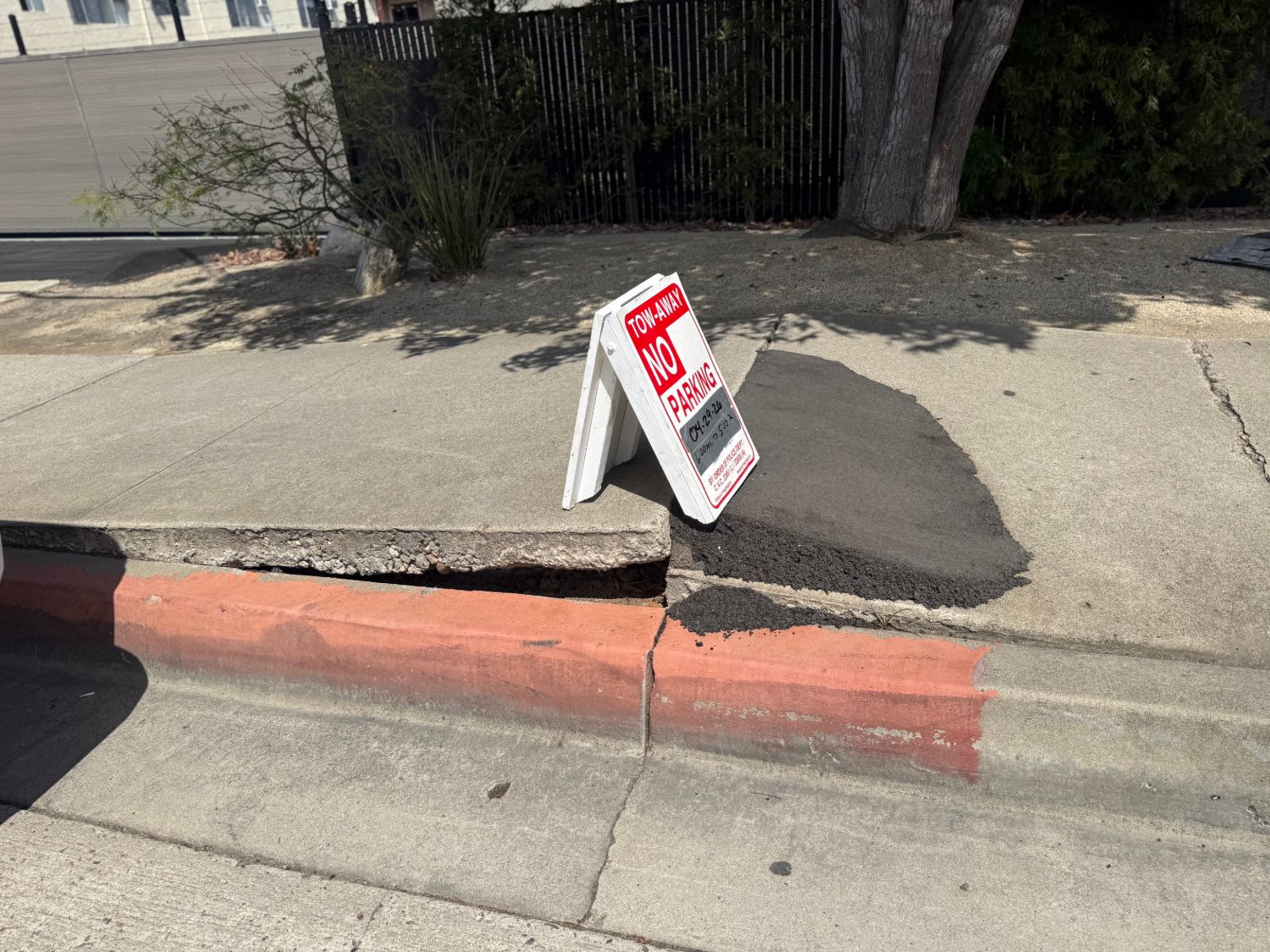
What that asphalt patch means
If the City smeared black asphalt over the lifted edge, that's a temporary trip-hazard mitigation, not the repair. The concrete still has to be replaced, and the notice's clock doesn't stop because a patch exists.
Your options, honestly
- Do nothing. Legal exposure continues, the City's timeline takes over, and the endgame can be a City-performed repair billed to you with a lien. Not recommended, but it is an option.
- Do it yourself. Legal, but rare: it still requires a City right-of-way permit, concrete work to City spec (SDG-159), possibly a licensed surveyor for monument certification, and closeout paperwork. Most owners who start this route don't finish it.
- Hire any licensed concrete contractor. Perfectly good option. Ask them who pulls the permit, whether their price includes the City's permit & inspection fee (roughly $3,500 on a standard job — paid to the City), and who files the closeout.
- Hire us to run the whole thing. We handle permit, repair, and closeout as one fixed-price job — and right now our $1,200 permit coordination fee is waived.
If you'd like it handled
Send us the address and we'll put a fixed-price estimate in front of you — usually within 48 hours, free, no pressure. If you have the notice, mention the case number and we'll pull the City's file on it.